


A SERIES of recommendations have been made by accident investigators following a collision between a tram and young cyclist in Audenshaw last year.
An 11-year-old boy was taken to hospital by air ambulance with serious head injuries after the incident that occurred at the junction of Kershaw Lane and Droylsden Road on September 1.
The child, who had been waiting at a pedestrian refuge before stepping out, fell partly under the left side of the tram. The positioning of the refuge is described as “unusual.”
Now, the Rail Accident Investigation Branch (RAIB) has issued a 55-page report into the collision. It identified several defects with the tram and also stated risk assessment processes did not identify the hazard to pedestrians created by the crossing layout until the tramway construction was advanced to a point where the design could not be easily changed.
The RAIB report said the accident occurred partly because the attention of the boy had been ‘probably focused’ on eastbound traffic (travelling in the direction of Ashton).
So he ‘may have been unaware of the tram’s westbound approach (towards Manchester) from the opposite direction’.
It also states the boy had not waited for the ‘green walking man’ at the Puffin crossing indicating it was safe to cross.

Now, as part of the recommendations, Transport for Greater Manchester (TfGM) and Tameside Metropolitan Borough Council (TMBC) should review the layout of the crossing.
Additionally:
• TfGM should review its safety management system to ensure adequate processes are in place, both within TfGM and within contractors employed by TfGM, to identify hazards and control risks at the design stage of tram-way projects.
• The Light Rail Safety and Standards Board (LRSSB) review the application of road safety audits as a means to identify and mitigate hazards during tramway development and construction projects.
• Keolis Amey Metrolink (KAM) should review the operational risk assessments covering the operation of trams across the Metrolink network for completeness and adequacy.
• TfGM and KAM should review the reliability, operation and maintenance of the sanding systems and CCTV systems on M5000 trams.
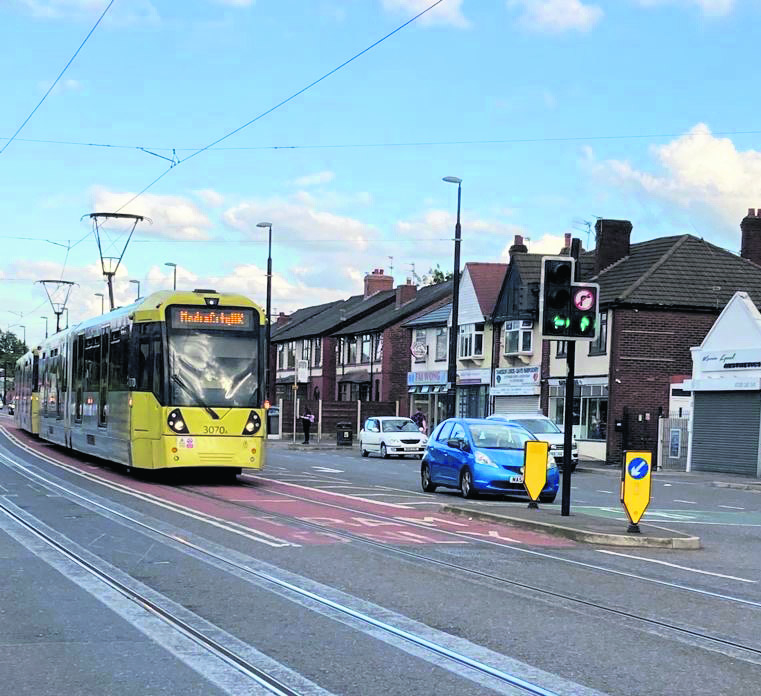
As part of the investigations, it was discovered three of the tram’s four sanders, which help breaking on the rails, were defective despite a maintenance check in July 2021.
Data collected indicated the tram experienced wheel slide after the hazard brake had been deployed.
It was stated this was the most likely reason for the tram braking at a rate slightly below that expected.
“This reduced braking rate may possibly have been avoided if all of the tram’s sanders had functioned correctly,” said the report.
Findings also showed the tram’s CCTV system was out of action. Investigators reported: “(A) functional CCTV system, including the forward-facing camera, would likely have provided imagery which would have been of considerable value to any investigation.”
A Tameside Council Spokesperson said: “Tameside Council fully supports the Rail Accident Investigation Branch (RAIB) report into the accident near Audenshaw tram stop on 1 September, 2021. We are pleased it notes that we freely co-operated in the inquiry.
“From the outset, we wish to make it clear that our main concern is for the 11-year-old boy who was seriously hurt and our best wishes and thoughts go out to him and his family.
“We will do all we can to prevent a reoccurrence of this terrible event, and to that end Tameside Council fully supports and accepts the RAIB report and its findings.
“In line with its recommendations, we commit to working in partnership with Transport for Greater Manchester (TfGM) on a full and independently reviewed assessment of the crossing and its layout to identify any measures we can implement to reduce risk.”
TfGM’s Head of Metrolink, Danny Vaughan, said: “This was a deeply upsetting incident that will have lasting consequences for the young boy involved and our thoughts remain very much with him and his family.
“Whilst light rail is a very safe mode of transport, when things do go wrong it is vitally important lessons are learnt from them. That is why we welcome the very thorough and detailed investigation carried out by the Rail Accident Investigation Branch.”